Yamaha SY85
A serious AWM2 workstation from 1992 — 16 MB of wave ROM, a built-in 16-track sequencer, and that rich, dense Yamaha sample-based sound that defined early-90s production.
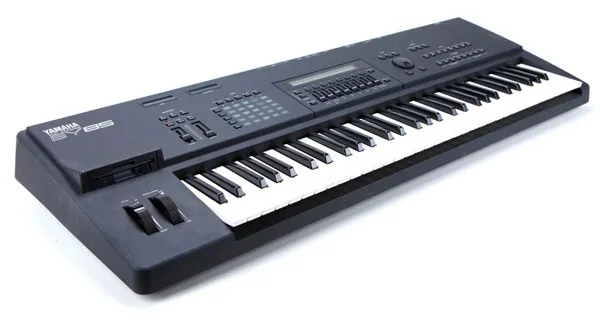
Overview
The SY85 sits at the top of Yamaha’s SY-series workstations from the early 90s. It uses AWM2 (Advanced Wave Memory 2) — Yamaha’s rompler technology with looped multi-sampled waveforms as oscillators, plus filtering and an extensive modulation matrix. Sixteen MB of internal wave ROM is substantial for 1992, giving the SY85 a wide palette of realistic acoustic sounds alongside pads, basses, and leads.
Thirty-two-voice polyphony, 16-part multitimbrality, and a 16-track sequencer made this a complete production tool. An optional SCSI port allowed connection to external drives — forward-thinking for its time.
The SY85 occupies an interesting place: it bridges the DX-era Yamaha digital character with the lush, layered sound design that would peak with the Motif series a decade later.
My unit
I bought it on February 13, 2022. The screen would light up, but it wouldn’t display anything, and essentially, the machine wouldn’t start. Pressing keys wouldn’t produce any sound, and the soft keys on the synth’s front panel didn’t function, etc.
Taking off the cover and examining the internal components was a bit tedious. It wasn’t designed with repair ease in mind.
The power supply was fine; eventually, after about two weeks of troubleshooting, a point was found where a trace on the board wasn’t making contact with a pin from an integrated circuit.
Essentially, this integrated circuit contained the firmware that the central CPU was trying to read during startup, and thus failing to boot. After adding a bit of wire as a bridge and ensuring the contact was correct, the machine started!
Unfortunately, the seller hadn’t disclosed all the issues the device had (and knew about, as later proved). That’s why I placed many different orders, which increased the repair cost.
I replaced the main volume slider with a new compatible one (it was for a motif) because the original one was burnt. I also replaced three broken black keys and one white key that was slightly melted from a cigarette. I replaced the broken power button. Additionally, I managed to find the previous owner before the one I bought it from because he still had the floppy drive of the synth along with a metal base for the drive. Without it, I wouldn’t be able to add another one if needed, like a new USB drive emulator. Basically, when I got the synth, it just had a hole. There was no drive.
After it finally worked, I proceeded to give it a thorough cleaning inside and out. I’ve never seen a dirtier device internally (or maybe I’ve seen another one). There was a lot of dust and rust in various areas. I assume it was probably used for concerts at festivals outdoors and left out overnight for the next shows. So, besides accumulating dust, it would have been exposed to a lot of humidity.
I also found spiders and other small dead insects and nymphs.
Fortunately, everything went well, and now it’s in very good condition and ready to live a second life. I’m considering using sounds exclusively from it for one of my upcoming projects.