Ensoniq TS-10
Ensoniq's TS-10 brought Transwave synthesis to the early 90s — dynamically animated oscillators that produce restless, evolving timbres unlike anything from Yamaha or Korg.
Overview
The TS-10 is the flagship of Ensoniq’s TS (Transwaves/Sequencer) series, and it’s one of the more distinctive synthesizers of the early 90s. Where most workstations of the era played static samples, the TS-10 used Ensoniq’s Transwave technology: oscillators that scan through a wavetable in real time, driven by velocity, modulation, or the onboard envelope generators. The result is sounds with an inherent sense of motion — pads that breathe and evolve, leads that shift character as you play harder.
Under the hood: 21-voice polyphony (with stereo pairs), Ensoniq’s excellent onboard effects processor (reverbs, chorus, delay — built in at a time when many synths had none), and a 24-track sequencer. The keyboard is 76 keys, unweighted but with aftertouch.
Ensoniq’s sound design philosophy was always a little different from the Japanese giants — the TS-10 has an organic, slightly unpredictable quality that gives it a personality of its own.
My unit
It was gifted to me by a musician who owned it but had it in a non-working condition. He had kept it from a friend of his with the intention of repairing it at some point, but time passed, he didn’t do anything about it, and when it was time for him to move, he couldn’t take it with him. That’s why he gave it to me.
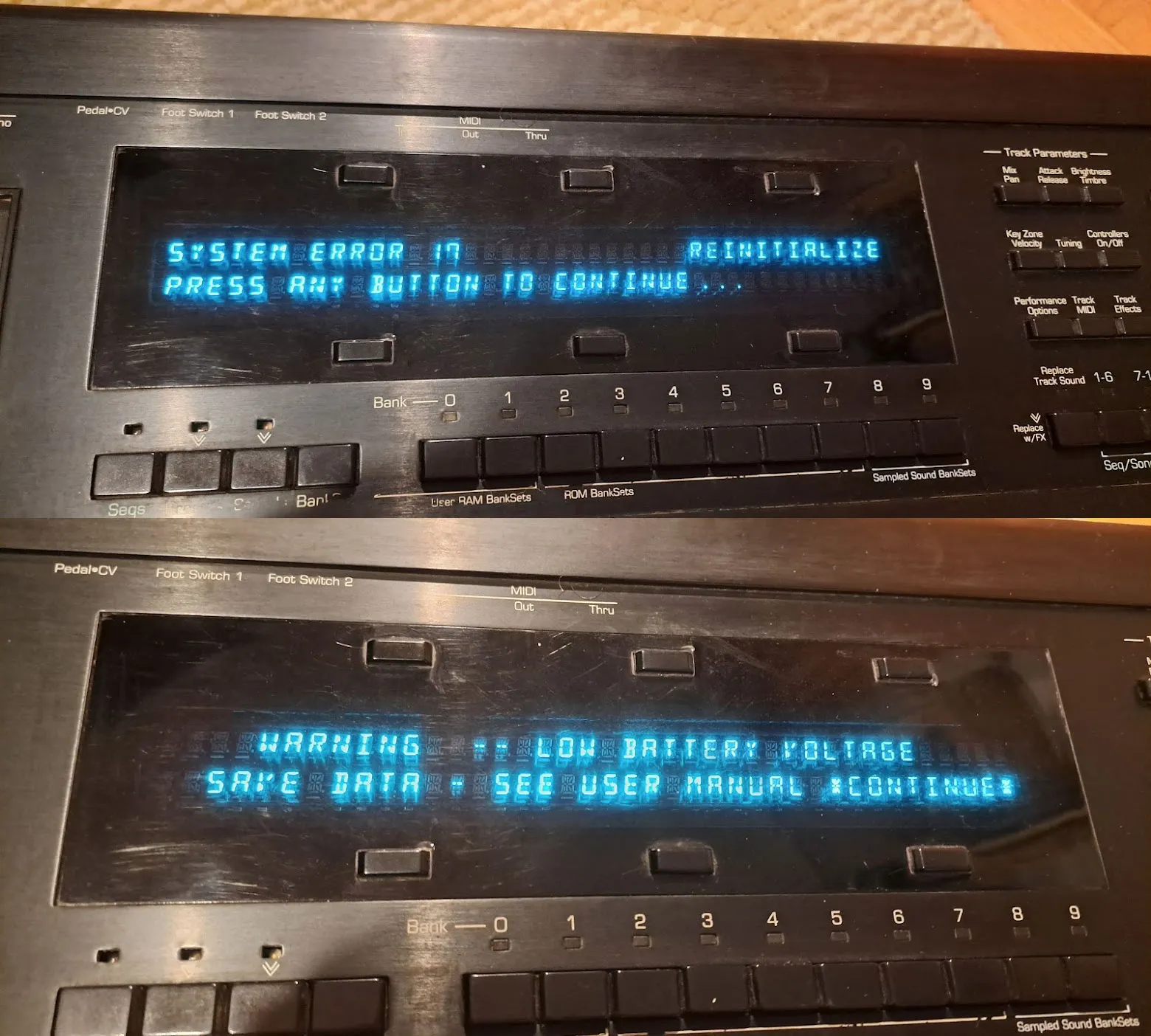
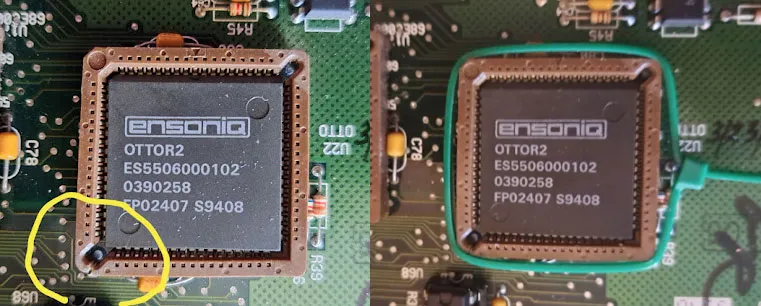
During the first test startup, an error message appeared with a code indicating an issue with the memory backup battery. After opening its case and replacing the battery (first installing a special socket to make future replacements easier if needed), upon startup, the machine displayed another battery-related error message, but in a different way. It said, “Low Battery Voltage.” After this message, the machine wouldn’t boot. After some time, I managed to identify the problem. The plastic base of an integrated circuit (OTTOR2) had cracked, and one side of it had slightly shifted/opened up, causing a pin from the IC to lose contact with the board. This pin was responsible for detecting the battery’s status.
Since I didn’t have a professional level of expertise in electronics repairs at the time, the first thing I did was tighten the plastic base with a cable tie to see if it would resolve the issue. And it worked! The machine started up! Unfortunately, I never proceeded with a proper repair, meaning I didn’t replace the IC’s base. However, the machine works perfectly fine.
This synth must be the dirtiest machine I’ve ever received. Its interior had dirt, traces of moisture, some rust, dead insects, and more. I assume it was used for outdoor concerts and was probably left outside overnight between performances. After a lot—and I mean a lot—of cleaning, I can say it was restored to a usable condition.
I also installed a USB drive emulator, purchased from monotanz. I haven’t explored it extensively yet, but it seems there’s a huge variety of sounds available online.
It has an exceptional sound for its time, and I’m planning to use it soon.